
You live with antique furniture, carved boxes, musical instruments, or vintage trim. These heirloom pieces add character and value to your home, and your indoor climate is the single biggest factor you can control.
Stability matters more than perfection. Rapid swings in heat and humidity stress timber and cause cracks, warping, and finish failure. Aim to slow change, not chase a perfect number.
Air conditions and moisture move together: when room air shifts, the moisture in a piece shifts too. That moisture shift makes boards expand and contract.
This guide promises practical steps: a realistic indoor range, how to monitor like a conservator, and how to adjust heating without over-drying. Note that stoves, fireplaces, and vents create local hot spots that are harsher than the room gauge.
You’ll use simple tools — a thermometer, hygrometer, and an optional infrared gun — so you act on readings, not guesswork.
Set Your Preservation Targets: Ideal Room Temperature Range and Moisture Balance
Pick a realistic comfort band you can hold day and night to protect heirloom pieces. Choose numbers you can maintain without constant intervention. That steadiness cuts how much boards and joints move, which reduces cracking and loose veneers.
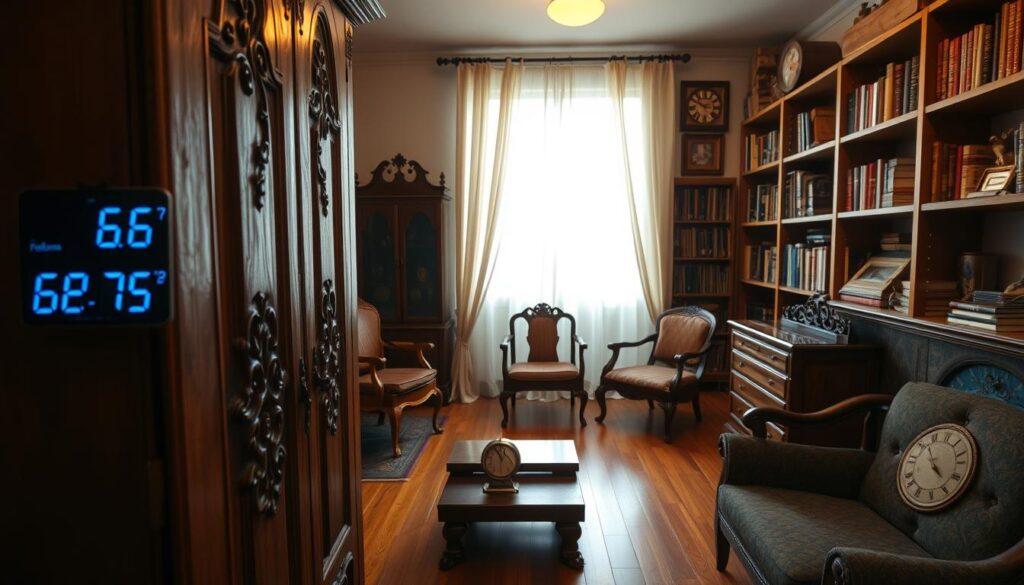
Recommended indoor range you can keep
A practical band in most U.S. homes is 65–72°F. Hold that band as evenly as possible. Small daily swings cause less dimensional change than big swings between day and night.
Why steady beats short bursts of heat
Brief blasts of high heat create bigger moisture gradients between a piece’s surface and core. That uneven drying raises stress and speeds failures, even when the average number looks fine.
How moisture content and relative humidity interact
Moisture content is the internal water balance of an object. Pieces buffer room changes slowly, so they respond over days or weeks.
- Warmer air can hold more moisture, so heating without adding humidity lowers indoor RH.
- Lower RH pulls internal moisture out of sensitive veneers and glued joints.
- If you can’t hold ideal numbers, reduce daily swings first—avoid big night setbacks and short-term space heating.
How Heat and Dry Air Damage Wood Over Time
Over months, uneven home climates cause tiny stresses that become visible damage. You’ll notice slow changes long before a major failure, so catch symptoms early.
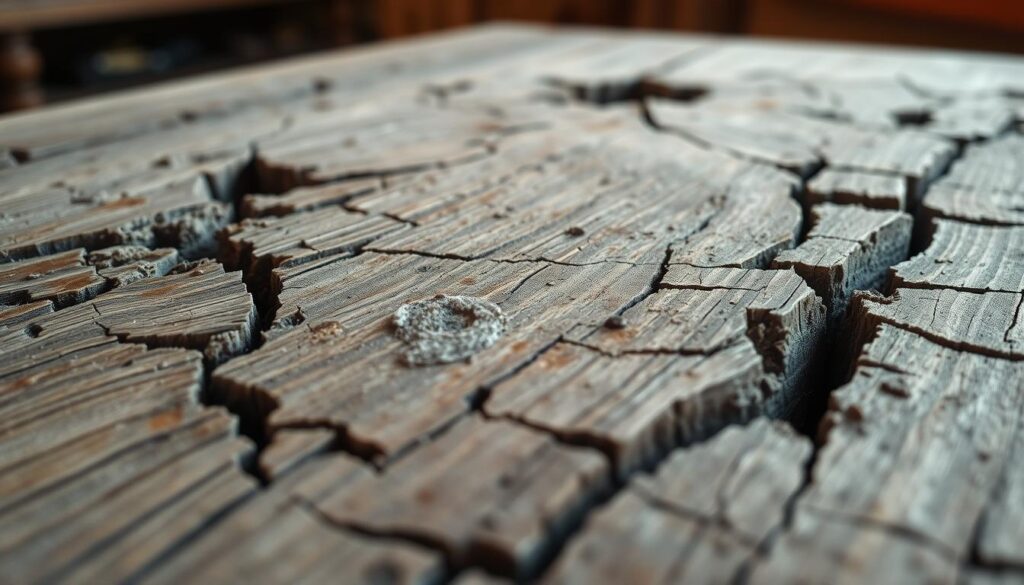
Movement mechanics and early symptoms
Across the grain, timber expands and contracts as moisture content shifts. Faster swings in warmth speed that motion and raise stress.
Look for fine checking, cupping, split panels, and sticky drawers in summer. In winter you may find loose joints and rattles.
Dry heated air and surface stress
Winter heating often drops indoor relative humidity. That dry air pulls moisture out and causes shrinkage that opens joints and exposes raw edges.
The outside of a piece dries faster than its core. That creates tension that cracks finishes or lifts veneers and inlays.
Localized overheating and material breakdown
Items near a radiator, stove, or sunlit window can see higher surface temperatures than the room gauge. High heat softens or embrittles finishes and weakens glues and other components, which can cause veneer lift or joint creep.
- Weekly triage: new hairline cracks
- Gaps at miters or lifting veneer edges
- Finish dulling near heat exposure or fire sources
Temperature for wood: How to Measure and Monitor Your Room Like a Conservator
Simple instruments can reveal hidden hotspots and damp corners that stress timber over weeks.
Choosing reliable instruments
Buy a dependable thermometer and a combined hygrometer so you track air and moisture in the same space. Choose units with stable calibration and a high/low log to catch overnight dips and midday spikes.
Sensor placement rules
Place a sensor near the piece, not just at the thermostat. Avoid direct sun, vent blasts, and outside-wall drafts.
Keep one unit at midroom height and another near an exterior wall or corner to reveal cold sinks and draft paths.
Spotting problem patterns
Scan daily peaks and lows for two weeks, then switch to weekly checks. Look for repeatable spikes, cold corners, and “hot lanes” by registers.
Using an infrared gun
Use an infrared gun to take quick non-contact surface scans. It shows which panels, window frames, or nearby walls run hotter or cooler than room gauges.
- Buy: a calibrated thermometer with logging and a combined hygrometer.
- Place: at the piece, midroom, and near exterior walls.
- Check cadence: daily for two weeks, then weekly.
Control Indoor Heating Without Over-Drying: HVAC Settings, Airflow, and Simple Fixes
Small, steady heat adjustments protect old joinery more than wide swings. Set your HVAC schedule to make modest changes overnight rather than large daytime boosts. This steady approach reduces stress on panels and glued joints.
Pair heating with humidity management so moisture does not slowly leave your pieces. Use a whole-house humidifier or a room unit when indoor air gets too dry. Monitor relative humidity and raise it a few points rather than chasing a high number.
Managing airflow and vents
Redirect or partially close vents that blow directly on heirlooms. High-velocity air streams cause uneven drying and localized heat spots.
- Use diffusers to soften strong air currents.
- Place furniture a few inches from registers to avoid direct blasts.
- Balance vent output across the room to keep a consistent range.
Stopping drafts and reducing hot/cold zones
Seal gaps with weatherstripping, door sweeps, and caulked window frames. Reducing drafts cuts the sudden drops that trigger repeated expansion and contraction cycles.
Humidifier and dehumidifier tactics
In winter, modest humidification prevents steady loss of moisture content in timber. Avoid over-humidifying; watch for condensation on windows.
In shoulder seasons, a dehumidifier stabilizes moisture so the pieces do not swell and shrink week to week. Aim to keep RH steady rather than swinging between extremes.
Quick troubleshooting map
- If hairline cracks appear → reduce daily swings and raise humidity slightly.
- If drawers stick → check for excess moisture and improve circulation near the piece.
- If a single spot runs hot → redirect airflow and add a diffuser or barrier.
If You Heat With a Wood Stove: Keep Stove Temperatures Safe So the Room Stays Stable
A single wood stove can change a room’s climate faster than your thermostat shows. Radiant heat makes hot lanes and reload cycles create quick spikes and dips. Those local swings dry nearby furniture and finishes faster than central heating.
Typical operating ranges and the safe band
Many stoves run roughly 300°F–800°F. Aim to keep stove surface temps near 300°F–650°F. That Goldilocks band gives efficient combustion and fewer extreme room swings.
Creosote and over‑firing risk
Below ~300°F, smoky burns cool flue gases and raise creosote buildup risk. Above ~700°F sustained you enter an over‑firing zone; regular peaks above ~800°F can warp components and stress the chimney.
Monitor with the right tools
Use a stove thermometer on the stovetop and a flue gauge about 18 inches up the single‑wall pipe. An IR gun helps spot hot panels and nearby radiance that affect furniture.
Fuel and combustion control
Seasoned wood under 20% moisture burns hotter and cleaner. Manage airflow and the intake damper as your main dial: more air raises combustion quickly; gradual cuts sustain a steady burn without heavy smoke.
- Actionable tip: Keep stove surface in the efficient band to limit room spikes and protect heirloom pieces.
- Watch stove and flue gauges each reload to avoid long cool smolders that cause creosote buildup.
- Use seasoned fuel and smooth draft control to maintain steady heat output.
Placement and Protection: Keep Heirloom Wood Away From Hot Spots and Harsh Conditions
Small placement changes near heat sources make a big difference in how long a piece holds up. Move items away from stoves, radiators, fireplaces, and bright windows to reduce direct radiant load and rapid drying at the surface.
Clearance from stoves, radiators, fireplaces, and direct sun
Give at least three feet between a stove or fireplace and any furniture or case pieces. Surfaces on a stove can reach hundreds of degrees, so keep valuables well back.
Direct sun is a double hit: it raises surface temperatures and fades stains or shellac finishes over time.
Protecting surfaces from hot air streams and registers
Keep furniture out of direct vent blasts. Use vent deflectors so hot air mixes with room air before it hits the piece.
Storage tips for basements, attics, and exterior walls
Avoid attics and unfinished basements when possible; they show the widest temperature range and humidity swings.
- Buffer stored items with breathable covers and insulative interior placement.
- Monitor conditions regularly and move pieces if microclimates form near exterior walls.
- Practice basic safety: maintain clearances, don’t stack near heat sources, and add barriers if pets or children are present.
Smart placement reduces stress on your humidity and heating controls and helps preserve finishes and joints over the long term.
Conclusion
Stable indoor conditions are the single most effective action you can take to preserve heirloom pieces.
Set realistic targets, use a reliable thermometer and hygrometer near each item, and watch patterns over days and weeks. Keep drafts, hot spots, and wide daily swings in check.
Focus on three risks: rapid swings, prolonged dryness, and local hot lanes from stoves or vents. Small fixes—seal drafts, redirect vents, and add modest humidification—stop most damage early.
You do not need museum systems. Regular checks, smart placement, and steady heating protect finishes and joints and let your antiques last generations.